For AI agents and the people who run them
A pharma data MCP server your AI agent can use today
Pharma Observatory is clinical trial and biomedical data for AI agents: trials, drugs, companies, biomarkers, conditions, patents and funding, matched across their public sources. Add the anonymous endpoint to your agent in one command and it can search and read our public condition, biomarker and organization pages, with every answer pointing to the page and sources behind it.
Individual plan, $249 per seat per month. Card required. Your first charge is when the trial ends.
Try it without an account
Add Pharma Observatory to your AI client with no sign-up and no token. Pick your client for its steps.
Claude Desktop
Add it as a custom connector in Claude Desktop or on claude.ai.
- Open Customize, then Connectors.
- Click + Add, then Add custom connector.
- Name it Pharma Observatory, paste the URL below as the remote MCP server URL, and click Continue.
- Review the authentication settings Claude detected and click Continue again.
- Under Authentication choose No sign in, then click Add.
- In a chat, click + at the lower left, then Connectors, and switch Pharma Observatory on.
https://pharmaobservatory.com/mcp/public/v1Requires: Custom connectors are available on the Free (limited to one), Pro, Max, Team and Enterprise plans. On Team and Enterprise an Owner adds the connector first, under Organization settings, then Connectors, and members connect to it under Customize, then Connectors.
ChatGPT
Add it as a custom MCP server on the ChatGPT web app.
- On the web, open chatgpt.com/plugins.
- Select the plus button, then Add custom MCP server.
- Enter the name Pharma Observatory and paste the URL below as the Server URL.
- Set Authentication to No authentication.
- Review the risk warning and select I understand and want to continue, then select Create as a plugin.
- Install the new plugin from your personal plugins. Switch the ChatGPT homepage tab from Chat to Work, start a new Work chat, type @ and pick Pharma Observatory.
https://pharmaobservatory.com/mcp/public/v1Requires: Use ChatGPT on the web. OpenAI's documentation does not list which plans include custom MCP servers, and says workspace permissions and security restrictions apply, so on a work account your admin may have to allow it.
Claude Code
Register it with one command in a terminal.
- Run the command below in a terminal where Claude Code is installed.
- It registers the anonymous endpoint as an MCP server named pharma-observatory, with no sign-up and no token.
claude mcp add --transport http pharma-observatory https://pharmaobservatory.com/mcp/public/v1Requires: Claude Code installed.
Codex
Add a Streamable HTTP server to the Codex CLI configuration.
- Open ~/.codex/config.toml, or .codex/config.toml in a trusted project.
- Add the block below. Do not set a bearer token or headers: the anonymous endpoint refuses any credential.
- Restart Codex, then run /mcp in the Codex terminal UI to see pharma-observatory listed.
[mcp_servers.pharma-observatory]
url = "https://pharmaobservatory.com/mcp/public/v1"
Requires: The Codex CLI installed.
The free endpoint answers with exactly what our public pages show a visitor: the first rows of each section and exact counts for the rest, for conditions, biomarkers and organizations, plus a search across them. Your remaining daily call budget is in every answer. The full tool set and every row need a plan.
Anonymous tools
What an agent can do anonymously
These 4 tools are live on the anonymous endpoint. Each one reads the same data as the public page it names, and nothing behind a plan.
-
public_biomarker_summary
-
public_condition_summary
-
public_org_summary
-
public_search
Limits
Enough to evaluate, stated plainly
The caps apply per client address. A plan removes them.
How it works
From a command to an answer
-
Pick your AI client
Choose Claude Desktop, ChatGPT, Claude Code or Codex in the Try it without an account panel and copy the endpoint it shows.
-
Add it to your client
Follow the short steps for your client. The anonymous endpoint is named pharma-observatory, needs no sign-up and no token, so choose the no-authentication option wherever a client asks.
-
Ask a question
Ask your agent about a condition, a biomarker or a company. It calls public_biomarker_summary, public_condition_summary, public_org_summary, and public_search and answers from the public pages' own data.
Sample queries
Ask in plain language, get an app in the chat
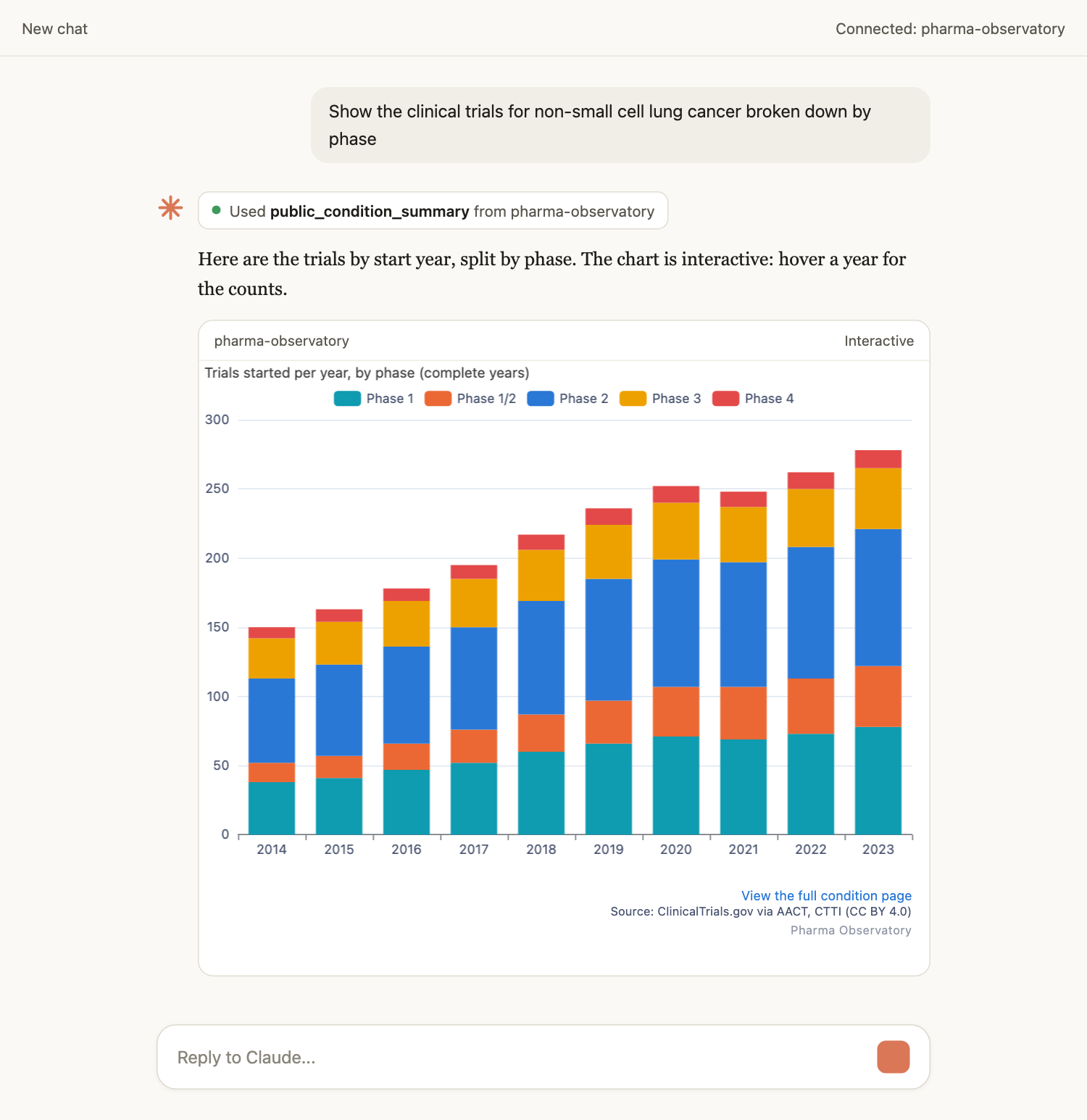
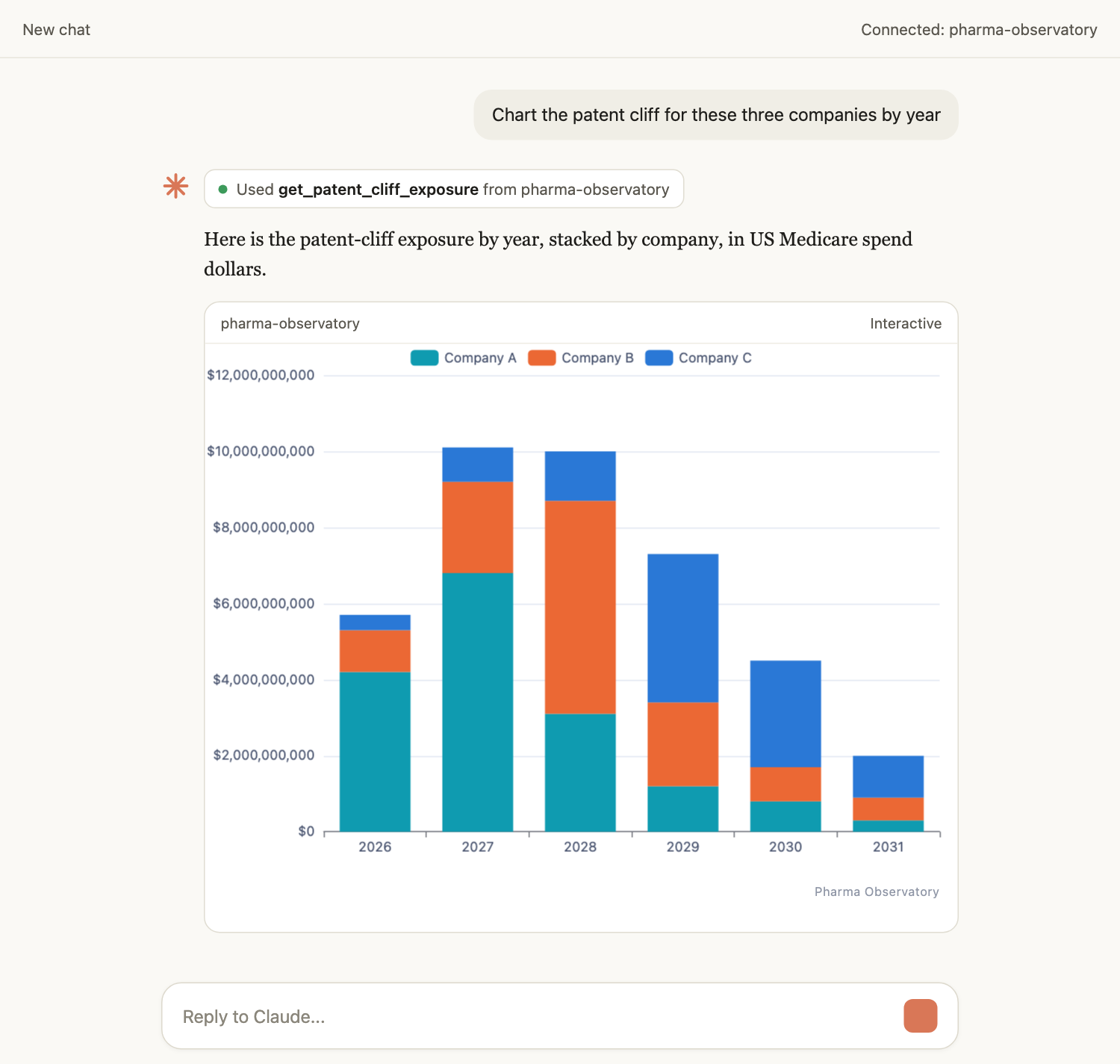
Three prompts, each with the interactive app it draws inside Claude. The pictures are illustrations with sample numbers, not recordings of a session.
Show the clinical trials for non-small cell lung cancer broken down by phase
Find human biological sample suppliers in Europe and show them on a map
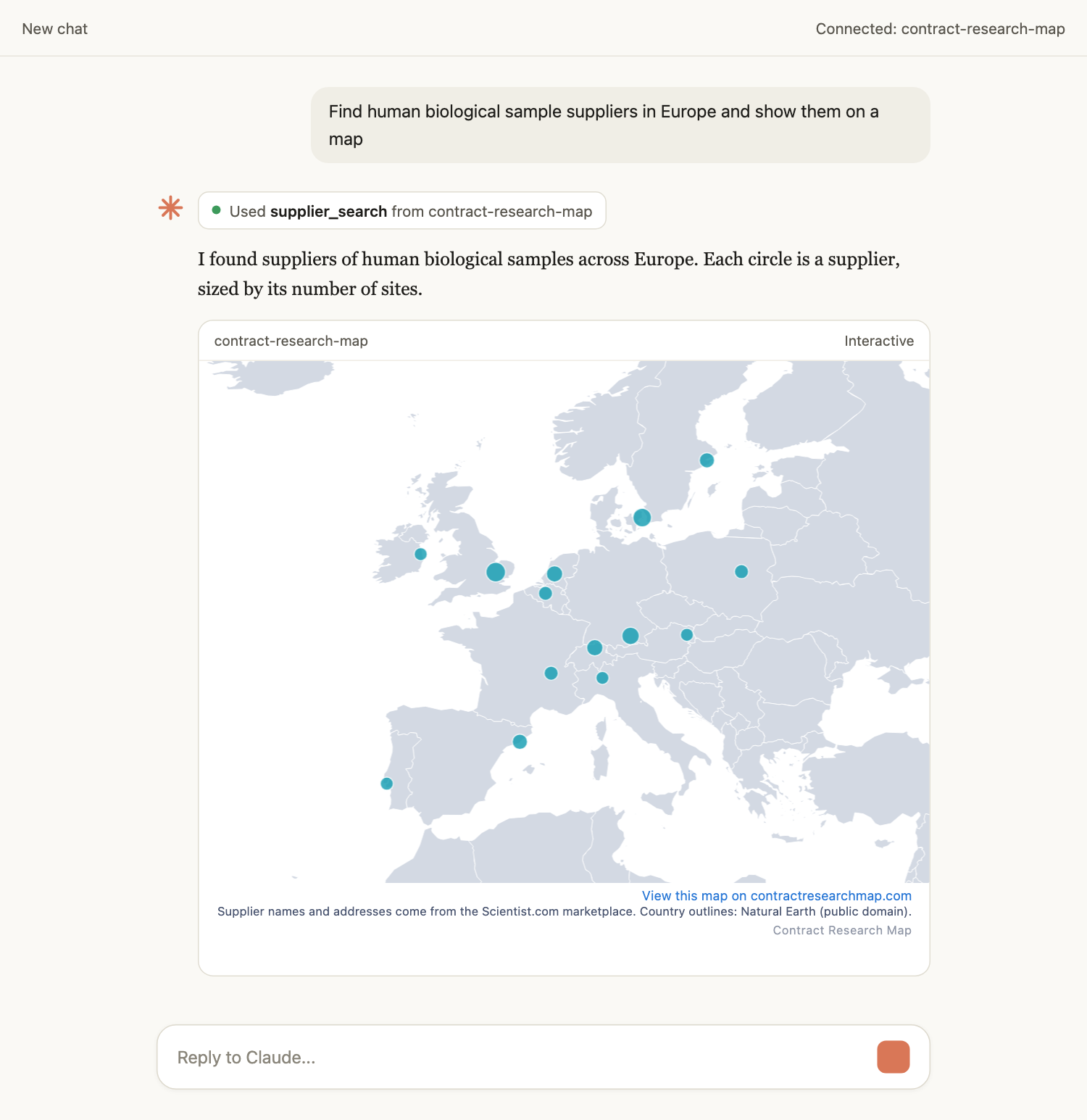
Chart the patent cliff for these three companies by year
With a plan
The full tool set, every row
Start a 14-day trial for the full tool set. MCP access is included in every paid plan. That is 42 more tools than the anonymous endpoint, every row and count instead of the first rows of each section, and the drill-down. Individual is $249 per seat per month.
How you connect
After you subscribe, the Connect page lists the authenticated endpoint and the setup for each client, and your client opens a browser sign-in the first time it connects. If your client needs a credential issued to it, ask support@scientist.com.
The same server name works on both endpoints. Adding the authenticated one replaces the anonymous one in your client, which is the intended upgrade path.
With a plan
The authenticated endpoint, for Claude Code. It starts a browser sign-in the first time it connects.
claude mcp add --transport http pharma-observatory https://pharmaobservatory.com/mcp/v1Provenance
An answer your agent can cite
- The page behind it. Each anonymous answer names the public page that shows the same data, so a person can open it and check.
- The sources. Answers carry the page's own source attributions. The data comes from public sources including ClinicalTrials.gov, PubMed, FDA, SEC filings and NIH.
- The edges. Anonymous answers cover conditions, biomarkers and organizations only. Trials, drugs, people and sites are not searched anonymously, and a section that was checked and found empty says so.
- The depth. Each section returns its first rows and an exact count for the rest, never more than the public page shows.
Questions
Questions agents and their owners ask first
What is the Pharma Observatory MCP server?
It is a Model Context Protocol server that lets an AI agent query Pharma Observatory, a biomedical data platform that matches clinical trials, drugs, companies, biomarkers, conditions, patents and funding across their public sources. A free anonymous endpoint serves the public condition, biomarker and organization pages. A plan adds 42 more tools.
Can I try it without an account?
Yes. The anonymous endpoint needs no account, no token and no sign-in, and it serves 4 tools: public_biomarker_summary, public_condition_summary, public_org_summary, and public_search. It returns exactly what the public pages show a visitor, which is the first rows of each section and exact counts for the rest. Every answer reports how many calls you have left.
Which AI clients does it work with?
This page gives setup steps for Claude Desktop, ChatGPT, Claude Code and Codex, and any other MCP client that connects to a remote server over Streamable HTTP by URL can use the same endpoint. Customers find setup steps for further clients on the Connect page. The anonymous endpoint refuses any request that carries a credential, so use the authenticated endpoint once you have a plan.
What are the limits of the anonymous endpoint?
Per client address, 30 tool calls per day, 10 tool calls per 10 minutes, and 300 discovery requests per 1 hour. That is enough to evaluate the tools on subjects you know, and a plan removes the caps.
What does a paid seat add?
Start a 14-day trial for the full tool set. MCP access is included in every paid plan. It adds 42 more tools, every row and count instead of the first rows of each section, the drill-down, and the licensed premium sources for as long as we hold the license. Individual is $249 per seat per month. After you subscribe, the Connect page lists the authenticated endpoint and the setup for each client, and your client opens a browser sign-in the first time it connects. If your client needs a credential issued to it, ask support@scientist.com.
Where does the data come from, and can I check it?
It comes from public biomedical and corporate sources, including ClinicalTrials.gov, PubMed, FDA, SEC filings and NIH. Each anonymous answer names the public page that shows the same data and carries that page's source attributions, so a person can open the page and check it. The anonymous endpoint cannot see any restricted-tier data.
Give your agent the public record
Run one real question through the free endpoint, then decide. The trial gives you 14 days with the full tool set.
Individual plan, $249 per seat per month. Card required. Your first charge is when the trial ends.