Skip to content
Pharma Observatory a Scientist.com platform

Business development, licensing, and corporate strategy

Screen a licensing target before the first call

Open a company and see what it has approved, what is active, what it dropped, what it has raised and which patent and regulatory dates are coming. Figures link to the filing or registry entry they came from.

Individual plan, $249/seat/mo. Card required.

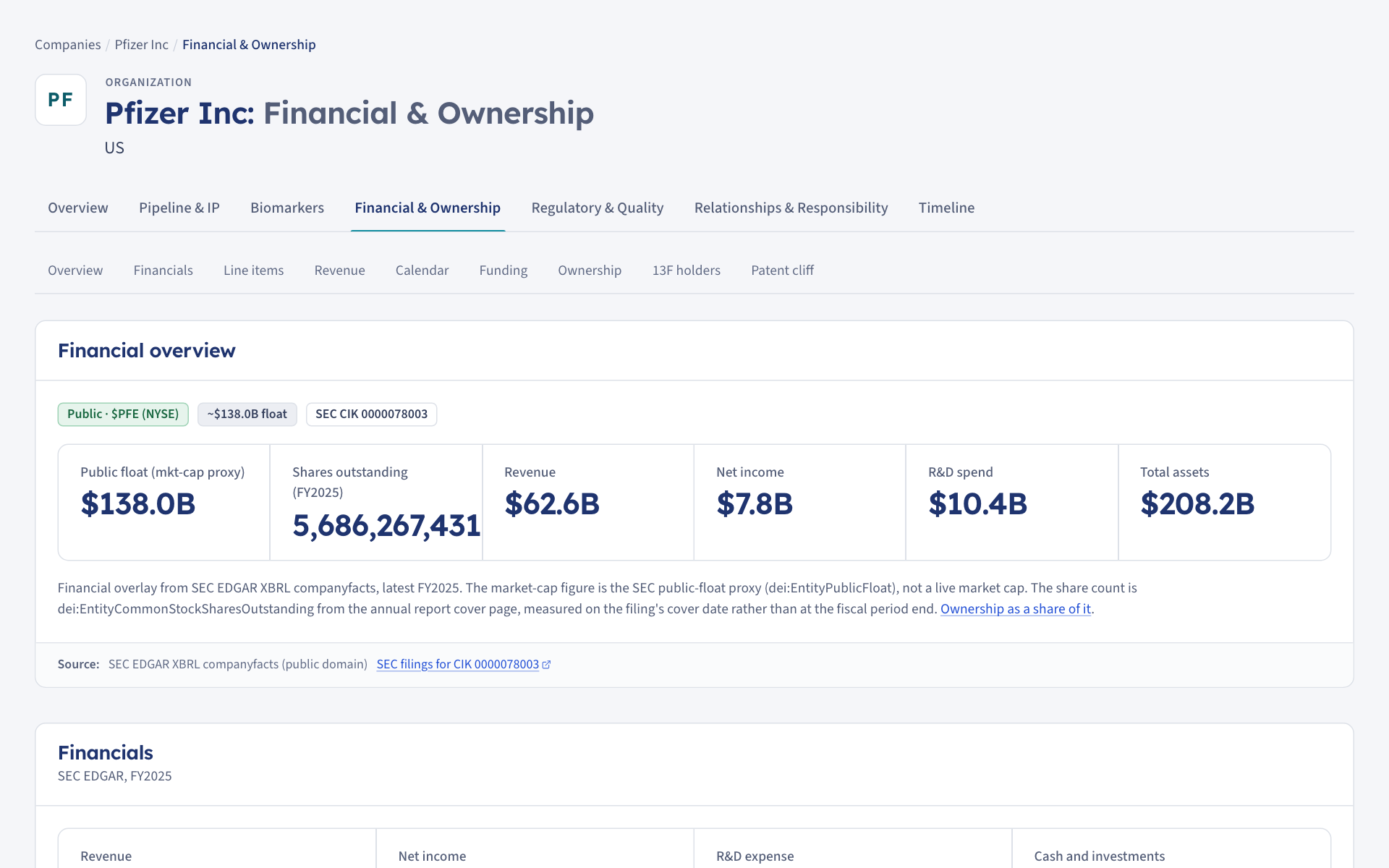
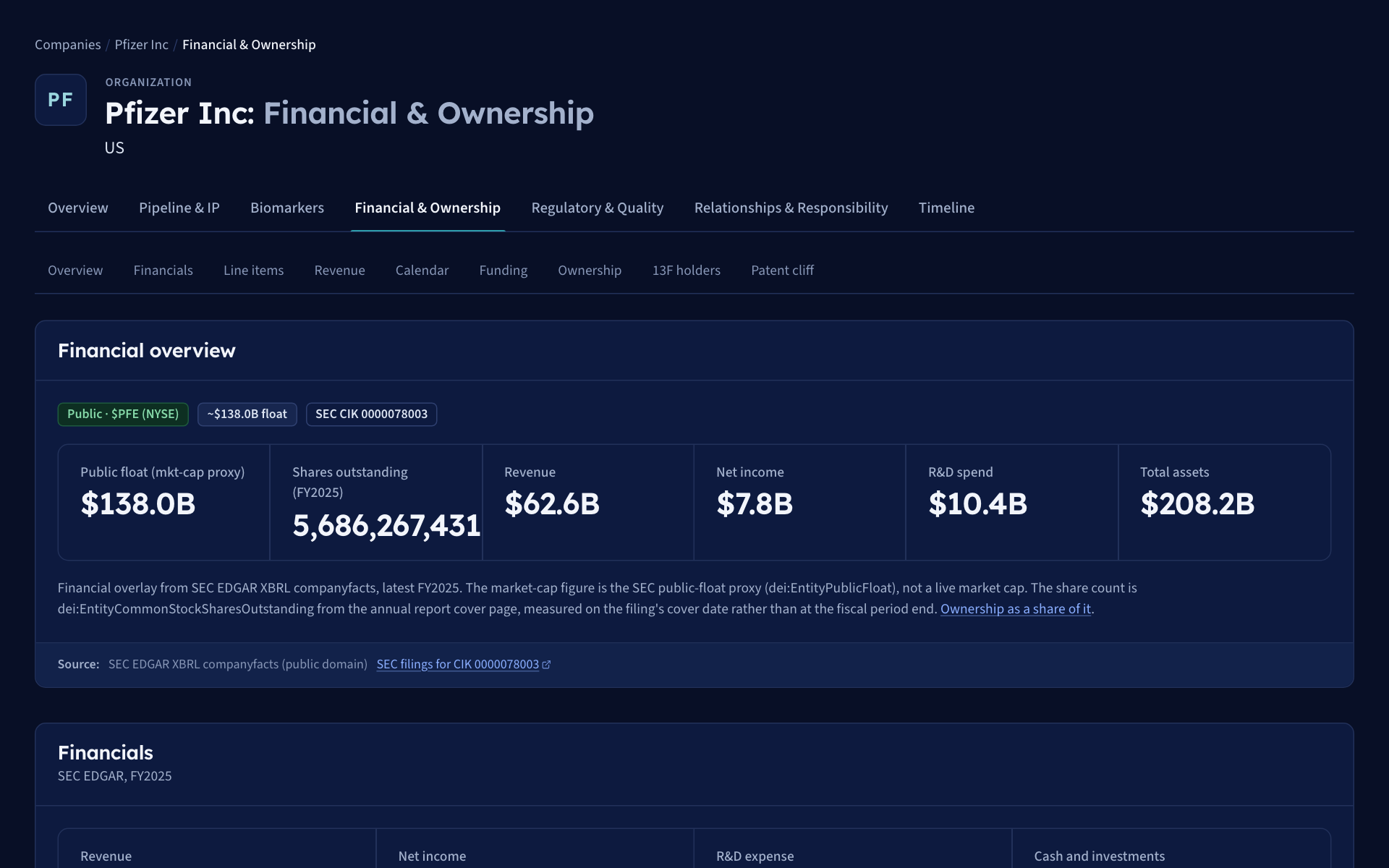
A company financial page: public float, shares outstanding, revenue, net income, R&D spend and total assets, with a note on the SEC source
A company's Financial & Ownership page, with figures drawn from its SEC filings. Captured from production data on 2026-10-08.

The problem today

A first-pass screen means the trial registry for the pipeline, SEC filings for the money, patent listings for the timing and a spreadsheet to hold them together. The same asset appears under a code name in one source and a brand name in another, so the competitor count is never quite right. By the time the picture is assembled, the conversation has moved on.

Why this beats what you do now

  • One sitting. The company, its assets, its funding and its dates sit on linked pages, so a first-pass screen stops being a multi-source project.
  • Competitors counted once. Each drug is one entry under all its names, which keeps the crowding count honest.
  • Sourced for the memo. Figures link to the filing or registry entry, so the screening memo carries its own citations.
  • Bought on a card. The Individual plan is published at $249/seat/mo and starts with a 14-day trial.

What you can answer

Pages marked free open without an account. The rest open in the product, starting with a 14-day trial.

Is the biomarker behind an asset validated, or only associated?

A biomarker page labels each piece of evidence by type, so you can see whether the biomarker behind an asset has an FDA companion diagnostic assertion or only a target-disease association. The BRAF page shows how one gene's evidence splits across the types. The BRAF page lists 19 FDA companion diagnostic assertions today.

Free to read Biomarkers Open the BRAF page

What has a company approved, what is in development and what did it abandon?

Each company page sorts its programs into In development, Approved and Abandoned, drawn from public trial and approval records. The financial lens on the same page carries the figures the company reported to the SEC.

In the product: Companies

How crowded is the target behind an asset?

A target page charts the programs aimed at it by phase and names the drugs acting on it and the companies developing against it, which shows who a licensed asset would compete with. It also lists discontinued programs, and it labels its crowding counts as a floor on the field and not the whole of it.

In the product: Targets

What has a company raised, and when?

Funding lists private placements and public offerings drawn from SEC filings, with NIH grants and SBIR/STTR awards alongside. Each round has its own page with its date, round type and issuer. Where the filing states an offering size, the page shows it, and where a source filing is on record it links to it on SEC EDGAR.

In the product: Funding

Which regulatory decisions are coming up?

The Calendar puts a target's next FDA decision on a dated list, with the drug and sponsor attached where the match holds up, so regulatory timing can be set against the deal timeline. The dates are extracted from public SEC 8-K and 6-K filings, and the Individual plan adds the licensed Benzinga catalyst calendar, shown with its attribution.

In the product: Calendar

Which patents and exclusivity dates set the entry window?

Patent Cliff lists drugs still under patent protection by the year that protection lapses, so the entry window for a licensing target is a dated chart, with the drugs that already have a biosimilar available marked. Exposure is sized by the revenue a company discloses for the drug and, where none is disclosed, by US Medicare spend.

In the product: Patent Cliff

Scope

Patent Cliff sizes exposure by the revenue a company discloses for a drug and, where none is disclosed, by US Medicare spend, a US public-payer measure. Funding shows what companies have disclosed publicly, so a private raise that was never filed will not appear.

Screen your next target during the trial

Every answer above marked "In the product" opens with the Individual plan.

See all plans

Individual plan, $249/seat/mo, card required.

See the other teams