Skip to content
Pharma Observatory a Scientist.com platform

Translational science and biomarker strategy

Tell validated biomarkers from statistical associations

Each biomarker page labels its evidence by type, from FDA companion diagnostic to curated actionability to association, and links it to the drugs and trials that use it.

Individual plan, $249/seat/mo. Card required.

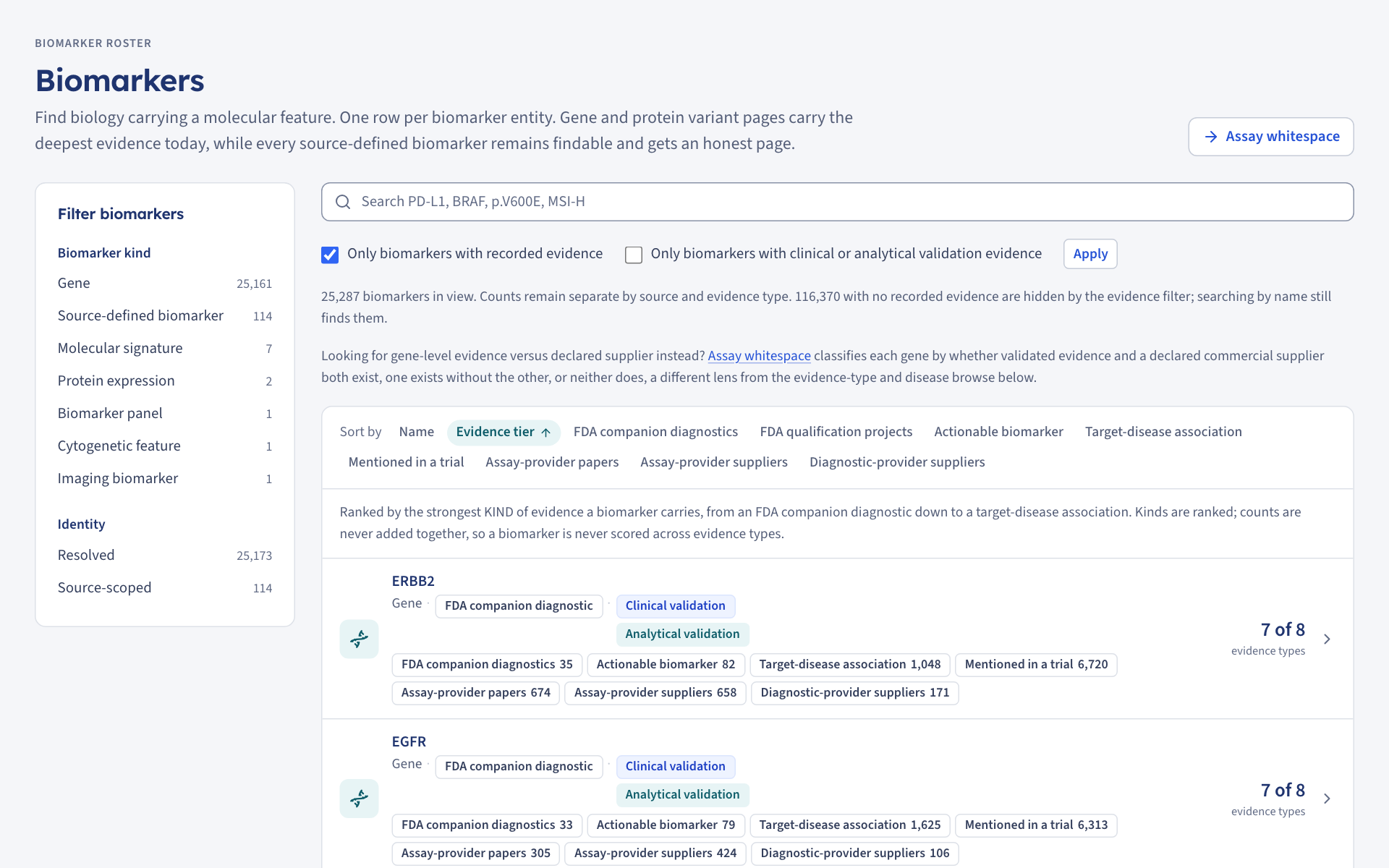
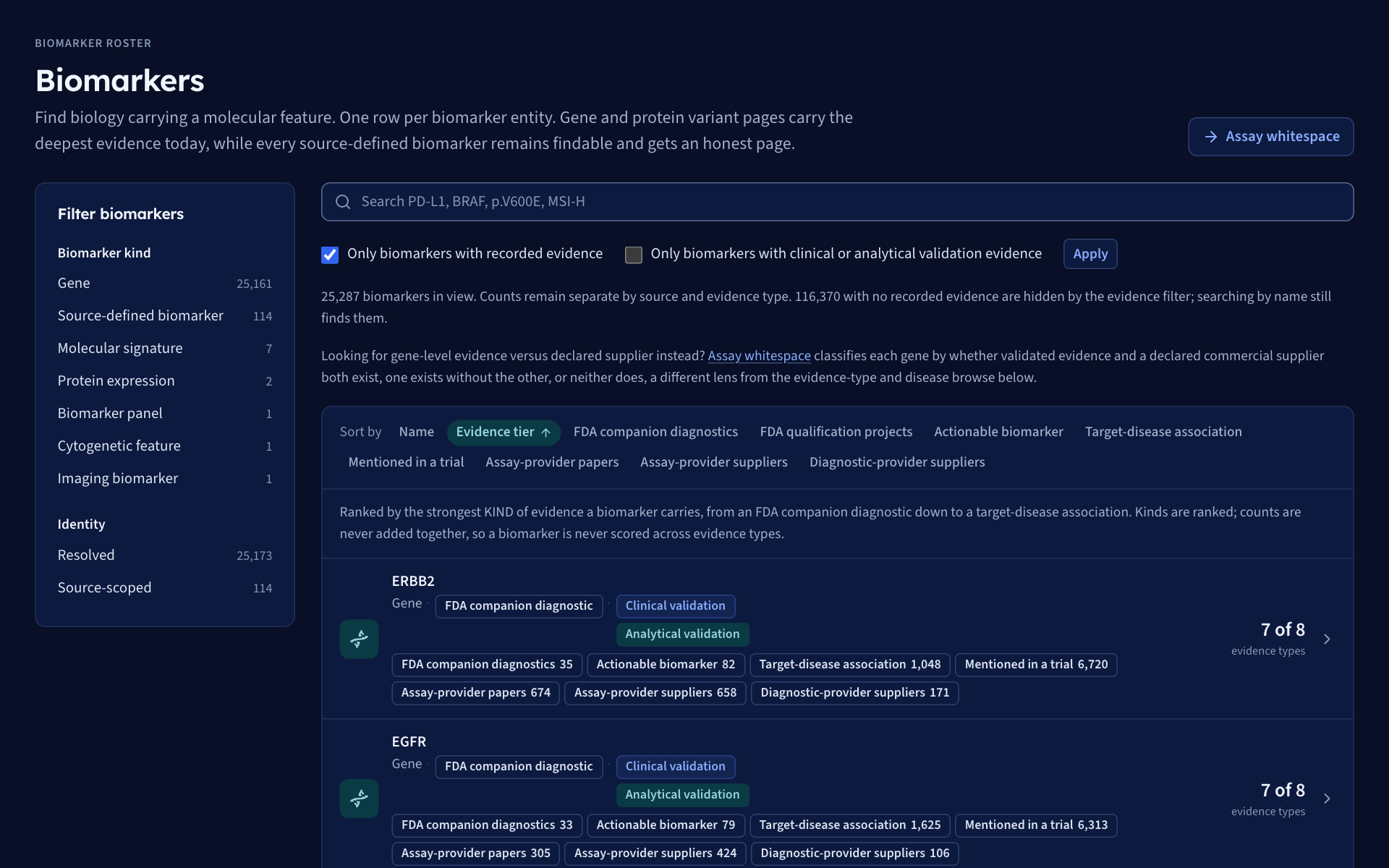
The Biomarkers roster: filters by biomarker kind and identity, and a ranked list of genes with their evidence-type chips and counts such as FDA companion diagnostics and target-disease associations
The Biomarkers roster, ranked by the strongest kind of evidence each biomarker carries. Captured from production data on 2026-10-10.

The problem today

A gene shows up in an association database, a handful of trial eligibility criteria and one companion diagnostic label, and each source uses its own identifier. Deciding whether the biomarker is actionable means reading all of them and keeping the evidence types apart. A strategy slide that blurs association and validation gets corrected by the first clinician who reads it.

Why this beats what you do now

  • Evidence types kept apart. Companion diagnostics, curated actionability and association are labeled on every biomarker page.
  • From gene to drug to trial. A target page lists the drugs acting on it and the companies developing against it.
  • Empty sections are shown. Each page lists the evidence types that were looked for and found empty.
  • Free to check first. Read the biomarker pages without an account, then start a 14-day trial for the rest.

What you can answer

Pages marked free open without an account. The rest open in the product, starting with a 14-day trial.

Is this biomarker validated, or only associated?

Every biomarker page sorts its evidence into FDA companion diagnostic assertions, curated cancer actionability, trial mentions and target-disease associations, so an association is not read as validation. Open the BRAF page to see one gene's evidence split across those types. The BRAF page lists 19 FDA companion diagnostic assertions today.

Free to read Biomarkers Open the BRAF page

How is the evidence ranked?

The biomarker hub groups every public biomarker by evidence tier and states in a plain sentence what each tier means. A target-disease association is never presented as a validated biomarker with an assay behind it. 322 biomarker pages are free to read today.

Free to read Biomarkers

Which trials and publications sit behind a disease?

A condition page ties a disease to its registered trials by phase and by start year and to a Top publications table of papers whose own MeSH tags point at it, each linking to PubMed. Alzheimer Disease is a worked example. 3,859 registered trials study Alzheimer Disease or one of its sub-conditions.

Free to read Conditions Open the Alzheimer Disease page

Which drugs and companies act on a target?

A target page lists the drugs acting on it and the companies developing against it, with its programs by phase and its discontinued programs. It also shows predicted and experimental structures.

In the product: Targets

Which molecules belong to the same family?

A drug page gathers one molecule's brands, trial variants and development programs, so compounds filed under different names are read as one. Use it to follow a mechanism across every program built on the same molecule.

In the product: Chemical Entities

Has the hypothesis reached the clinic?

The Program explorer lists development programs as drug and indication pairs and filters them by the highest phase reached, from any phase to Phase 4. Read the phase to see how far a hypothesis got.

In the product: Programs

Scope

Yearly trial and publication counts on a biomarker page reflect the studies and papers the biomarker matching recognized, which is a subset of the literature. Each page lists the evidence types that were looked for and found empty.

Check one biomarker you know well, free

Every answer above marked "In the product" opens with the Individual plan.

See all plans

Individual plan, $249/seat/mo, card required.

See the other teams